Fractional vs Full-Time CMO: How to Know Which One is Better for Your Business
If you are growing your business and starting to think seriously about marketing leadership, chances are the question of hiring a CMO has come up. And right behind it comes another question that does not always get enough attention: does that CMO need to be full-time?
It is one of the most important hiring decisions a growing business can make — and the answer is not the same for everyone. The right choice depends on where your business is right now, where you want it to go, and what your budget actually looks like.
This article breaks down the difference between a Fractional CMO and a full-time CMO: what each one actually means, and how to figure out which makes the most sense for your business.
What is fractional marketing leadership?
Fractional marketing leadership means bringing in a senior leader such as a Fractional CMO or part-time marketing director for a set number of days per month or week, depending on the needs of the business.
Unlike a marketing freelancer, who would be typically hired to deliver specific outputs, or a marketing agency, which typically delivers channel execution, a Fractional CMO is brought in to provide executive marketing leadership in terms of strategic direction, decision-making, accountability and the alignment of marketing outcomes with overall business goals. A Fractional CMO can also manage budgets, align internal teams such as sales and marketing, and ensure performance is measured against meaningful KPIs instead of vanity metrics.
A Fractional CMO is a senior marketing executive who works with your business on a part-time or project basis. They bring the same level of strategic thinking and leadership you would expect from a full-time hire — just without the full-time commitment or cost. Think of it as having access to C-suite marketing expertise exactly when and where you need it. A Fractional CMO will typically work across a handful of clients at any one time, which means they bring a broad range of cross-industry experience and a fresh, objective perspective. They are not just executing tasks — they are setting strategy, leading your marketing function and helping you make smarter decisions about where to focus your efforts. For a lot of growing businesses, that combination of high-level expertise and flexibility is exactly what they need to get to the next stage.
What Does a Full-Time CMO Actually Do?
A full-time CMO is a permanent member of your leadership team, fully dedicated to your business and your business alone. They own the entire marketing function from top to bottom — everything from setting the long-term strategy to managing the team that delivers it day to day. Since they are embedded in your business full-time, a permanent CMO gets to know your company inside out. They build relationships across the organisation, develop a deep understanding of your customers and take real ownership of your marketing results over the long term. For larger businesses or those with complex, fast-moving marketing operations, having that level of dedicated focus and continuity can make a meaningful difference. The trade-off, of course, is cost and commitment. A full-time CMO is responsible for:
Setting the overall marketing strategy and aligning it with business goals
Owning brand positioning, messaging and market differentiation
Leading demand generation, lead acquisition and pipeline growth
Managing the internal marketing team and external agency partners
Overseeing campaign planning, execution and performance
Building budgets, allocating spend and tracking ROI
Reporting on marketing performance to the leadership team or board
Driving collaboration between marketing, sales, product and leadership
Identifying new growth opportunities, channels and market segments
Creating accountability across the marketing function
Fractional CMO vs Full-Time CMO: What’s the Difference?
The biggest difference? Money and flexibility.
A full-time CMO comes with a hefty salary, benefits, and a long-term contract. A fractional CMO? You only pay for the time you need. Plus, they bring fresh ideas from working across different industries, which is great if your marketing needs a shake-up.
How Do You Know If You Need a Fractional CMO?
Not sure if a fractional CMO is the right move? Here are a few signs it might be time:
Your business is growing, but your marketing feels all over the place.
You need expert marketing leadership, but a full-time hire isn’t in the budget.
You’re launching a new product, raising funds, or expanding and need serious guidance.
Your marketing team is talented but lacks direction.
You’re spending way too much time on marketing when you should be focusing on running the business.
A Fractional CMO tends to be the right fit when your business needs proper marketing leadership but is not quite ready for a full-time executive hire. That might look like a startup that has found its footing and is ready to scale — our article on how the Fractional CMO model works for startups goes into this in depth — a growth-stage business that has outgrown ad hoc marketing but does not have the budget for a permanent CMO, or an established business going through a specific transformation or launch that needs senior strategic input for a defined period.
They are also a strong option if you have never had a CMO before and want to build out your marketing strategy and infrastructure before committing to a permanent hire. A Fractional CMO can come in, assess what you have, build the foundation, and help you understand what a full-time role should eventually look like when the time is right.
When hiring a Fractional CMO is not the right approach?
Where a Fractional CMO is probably not the best fit is when your marketing operation has grown to a point where it genuinely requires full-time dedicated leadership. If you have a large internal team, complex multi-channel campaigns running constantly, and marketing sitting at the very centre of your day-to-day operations — particularly as you approach £5–10 million in revenue — a permanent CMO who is fully invested in your business is likely the stronger choice. The honest answer is that a lot of businesses hire a full-time CMO before they actually need one. If you are not sure which camp you are in, that is usually a sign it is worth exploring the fractional route first.
That being said, here’s some clearcut criterion to determining when a fractional or a full-time CMO might be what your business needs.
In order to figure that out, there’s a few questions worth asking.
Do you have a clear marketing strategy, or are you still figuring it out? If your messaging isn't defined and you're unsure which channels are worth the budget you've allocated, a full-time CMO will likely spend their first several months building the same foundation that a fractional CMO could establish much faster.
Do you have a marketing team that needs leadership, or a gap that needs filling entirely? A fractional CMO isn't a substitute for a marketing team. If you have capable people who need direction and an experienced strategic voice, a fractional engagement is often exactly the right layer. If you need someone managing headcount and presenting to the board on pipeline, you likely need a full-time role.
What does your budget allow? If a $300,000-plus executive hire strains your resources, fractional gives you access to senior-level thinking while freeing up budget for the actual channel investments they recommend.
How quickly do you need results? Hiring a full-time CMO is a long process. A fractional CMO can onboard quickly and add strategic value almost immediately, which matters when your pipeline needs attention now.
When does a fractional CMO make sense?
A fractional CMO tends to be the right fit when:
You have a capable marketing team, but no one with real strategic authority over priorities and direction.
Your marketing and sales teams are misaligned, and leadership doesn't have the bandwidth to fix it.
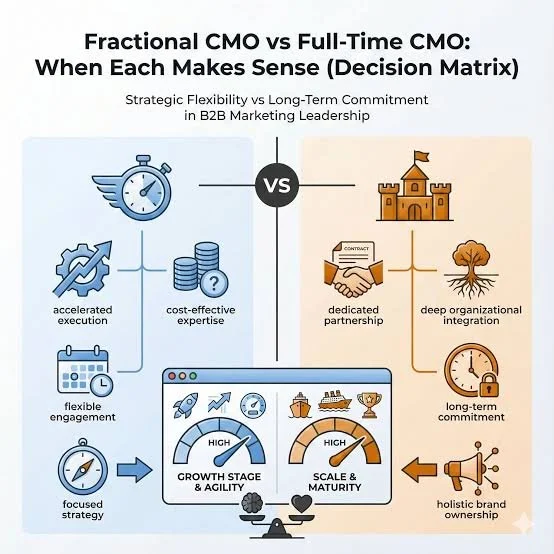
You're growing but don't yet have the scale or budget to justify a full-time executive hire.
Your marketing feels inconsistent, and you're not sure what channels to invest in
You're between full-time CMOs and need experienced leadership to keep marketing running and producing results
When does a full-time CMO make sense?
A full-time hire makes more sense when:
Marketing is the primary driver of company revenue, with clear pipeline accountability.
You have a marketing team of five or more people who need dedicated leadership and coaching.
You've reached a scale; typically Series B or beyond, or $10 million-plus in revenue where part-time oversight becomes a bottleneck.
Team-building and long-term brand guardianship are mission-critical priorities.
Is there an effective way to transition between fractional and full-time CMO leadership?
In a word. Yes.
With fractional marketing leadership, you gain the experience of a chief marketing officer or a senior marketing director who has shipped dozens of plans. That experience reduces rookie mistakes and compresses the time to a working marketing engine. You get top-tier messaging, channel strategy, and analytics without paying for a permanent executive suite. You keep the relationship focused on outcomes such as pipeline quality, sales enablement, and churn reduction. You also keep the option to convert the relationship later if your scale merits a full-time hire or hiring another person as a full-time CMO to build off what the fractional CMO has started to built or has built.
A fractional CMO engagement done well lays the groundwork that makes a future full-time hire more successful. By the time you're ready to bring someone on full time, your marketing strategy is clear, the team is aligned, reporting infrastructure is in place, and you know exactly what you need that person to own.
Think of it less as "fractional vs. full-time" and more as "what does this stage of growth actually require?" For most companies still finding their marketing footing, the fractional model isn't a compromise. It's a smarter starting point.
If you feel your business might potentially benefit from having a fresh perspective and bringing on an experienced marketing leader to help organize your marketing efforts, please schedule an introductory consulting call with us. We look forward to meeting with you and learning more about your business.